Category: Issue Tracking

  • Jellyfin for Music so far…

    While I bought a perpetual Plex license ages ago, I haven’t tried it for music yet. I opted to try Jellyfin first out of curiosity and see how easy it would be to get going in about 1 hour. From installing Jellyfin (on a non-LTS Ubuntu) to adding media, installing an iOS client, and playing music has come in just under that.

    Main issues so far:

    1. The official Jellyfin app doesn’t keep playing music on an iOS when closed.
    2. Tried Finamp briefly, worked, but no Carplay.
    3. Moved to Manet Music (which has a paid tier for Mac support) and so far working overall.

    Might try Plex music to see how it compares. Being able to call out tracks for a toddler on a roadtrip would be a north star to aim at for sure. So far, good.

    Updated and Retried on iOS and Ubuntu 25.04 2025/11/07
  • Running Immich on an Intel N150 with 70k+ photos is, maybe, not advisable

    Running Immich on an Intel N150 with 70k+ photos is, maybe, not advisable

    Revisited: Great results here!

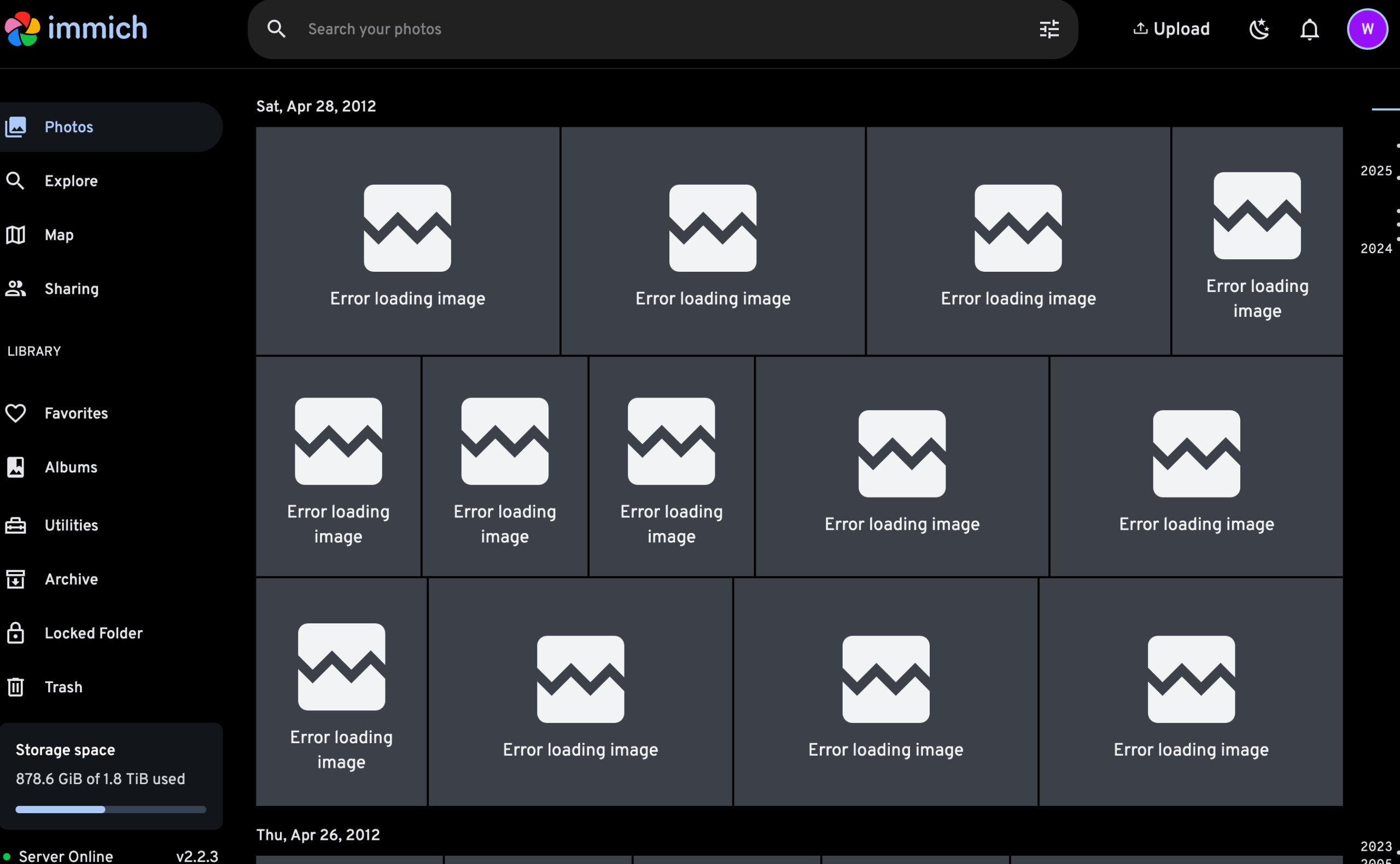
    Another back and forth between software options this time Immich versus Photopixel. Photopixel was, fine? But not great. So I’ve set up the Docker Compose for Immich and pointed it to 2 external libraries to start digesting. While it is surely pulling everything in it is doing so slowly. Nearly all images are showing “Error loading image” without much explanation. That said, older years are starting to show thumbnails and open fully after about 8-10 hours of processing.

    Ideally, this would be set up as a Kubernetes cluster but, not having done that before, that will take some time to learn.

    On Photopixel. I wouldn’t dissuade folks from trying it but my issues were:

    1. Performance. Thumbnails, even on a faster system, seemed to take a while to populate while scrolling. So far Immich shows blurry previews quickly and resolves to a preview much faster.
    2. UX for downloads. It was a pain to get to a download of an image. You have to go through a couple clicks to just download the file, Immich it’s right at the top.
    3. UX overall. Not going to be exhaustive here but overall Immich feels like photos stay front and center and menus are thoughtfully off to the side and laid out well in the options rather than being so front and center with Photopixel.

    Need to do a proper breakdown but happy with Immich so far, just a little painful with a large library and a fairly “slow” system.

    Updated and Retried on Ubuntu 25.04 and a 16 GB RAM Intel N150 2025/11/10

  • Moving MacOS local iOS backups for maximizing space

    Ditching all cloud services is not easy considering just how convenient so many of them are and how much space some of these services can take. Backing up a phone and tablet, particularly and iPhone and iPad Pro can take as multiple terabytes and often Mac’s have smaller primary storage. (I wonder why Apple…) Fortunately with a USB-C drive and a symlink, you can get basically unlimited storage for backing up devices.

    (Obviously update the paths for your set up as needed.)

    ln -s "/Volumes/DockedOrbit/PhoneandPadBackups/Backup" ~/Library/Application\ Support/MobileSync

    Updated and Retried on MacOS 26.0.1 11/05/25

  • Jellyfin Docker Compose is Brilliant

    After the little snafu of DuckDuckGo’s Assist box showing non-official directions, I tried the Docker Compose install and, with just a little set up.

    My docker-compose.yml here. Most of the changes are commenting out the user, running it as root, and hiding the environment configuration for now.

    Also note using the Plex media folder for everything, which is not the best idea. Here permissions wasn’t an issue, running as root, but probably should move things around and have this properly organized. For now though, everything gets dumped in there.

    So far, using Jellyfin as a music streamer with a specific client, Finamp, works great.

    services:
      jellyfin:
        image: jellyfin/jellyfin
        container_name: jellyfin
        # user: plex:plex
        ports:
          - 8096:8096/tcp
          - 7359:7359/udp
        volumes:
          - ./config:/config
          - ./cache:/cache
          - type: bind
            source: /var/lib/plexmediaserver/Library/audio/
            target: /media
          # Optional - extra fonts to be used during transcoding with subtitle burn-in
        restart: 'unless-stopped'
        # Optional - alternative address used for autodiscovery
        # environment:
          # - JELLYFIN_PublishedServerUrl=http://example.com
        # Optional - may be necessary for docker healthcheck to pass if running in host network mode
        extra_hosts:
          - 'host.docker.internal:host-gateway'

    Updated and Retried on 25.04 11/04/25

  • Potential F3800 API Options

    Update: There is an MQTT sensor API!

    Following up on the F3800, otherwise quite good dual voltage standalone home backup but sans API, there are attempts at connecting to the unit. The standout is GitHub thomluther’s builds for Solix products but these are mainly balcony units outside the US. https://github.com/thomluther/ha-anker-solix

    Second there is an attempt at connecting via the Bluetooth local connection but, when I tried it, it didn’t easily connect and my bit registers seemed to be different so any updates by Anker might completely wreck the IO. https://github.com/tiger2380/anker_f3800_web

    For the first, the issue is the F3800 (plus or non I am guessing) doesn’t create a System (as defined in Anker’s config) so the endpoints are not available. That said, once connected to WiFi the unit can be managed from any location, not just on the same network, so the unit has cloud management but the endpoints aren’t clear. The second API option, tapping right into the local Bluetooth, would be ideal but relying on reading bit output has any number of issues.

    There are Ecoflow HA options and it would be interesting just to see what the potential is there.

    Updated and Retried with Firmware v2.4.0: 12/03/25

  • Avoid MacOS Time Machine issues with Ubuntu SMB by Separating Users

    Avoid MacOS Time Machine issues with Ubuntu SMB by Separating Users

    Warning: Manage SMB users carefully.

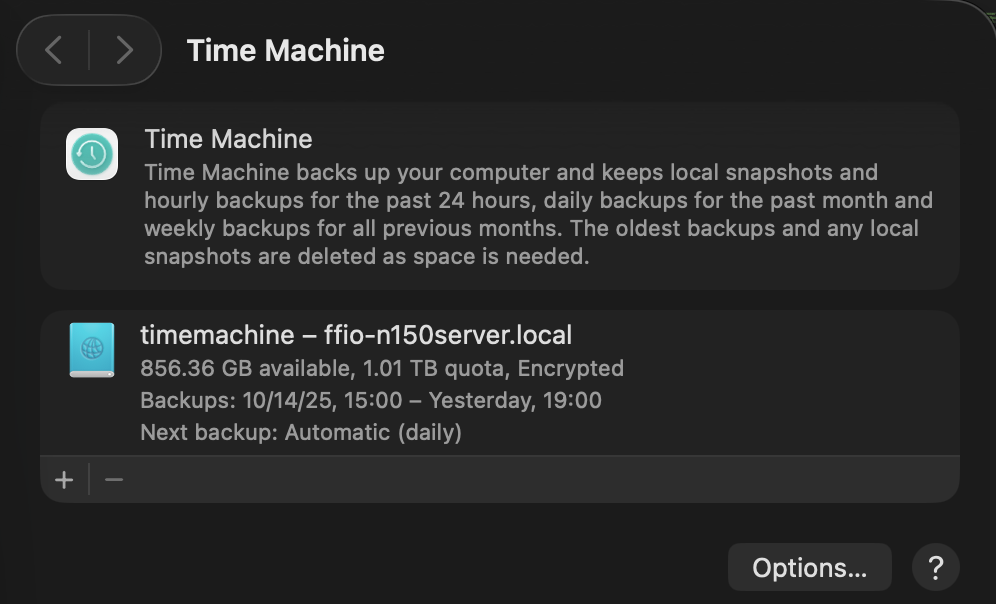
    Using Time Machine along with SMB shares seems to cause an issue when the backup runs the other SMB shares stop working. What is likely happening is MacOS is locking the files as it starts the backup to avoid read write problems.

    Separating the users, as in having one SMB user for files sharing and a second for Time Machine seems to solve the issues.

    Fortunately, setting up an SMB share for Time Machine is pretty straightforward and developer Marinus Klasen has a great guide. I’ve simplified what is needed an added it below at the bottom. General steps.

    1. First, create the users and set up the disks on Ubuntu. Add 2 SMB users (guide on that below.)
    2. Update the Ubuntu’s SMB settings.
    3. Set up Time Machine on MacOS before connecting to SMB shares. The share you’re looking to use should show in the list.
    4. Connect to your other SMB shares and go!

    There’s a great quick guide on ask Ubuntu about adding a CLI only SMB user on Ask Ubuntu.

    ## For TimeMachine Config ##
    # Fruit global config
      fruit:aapl = yes
      fruit:nfs_aces = no
      fruit:copyfile = no
      fruit:model = MacSamba
    
    [timemachine]
       # Load in modules (order is critical!)
       vfs objects = catia fruit streams_xattr
       fruit:time machine = yes
       fruit:time machine max size = 1.5T
       comment = Time Machine Backup
       path = /TimeMachine (CHANGE THIS)
       available = yes
       valid users = timemachine (Maybe don't permit other SMB users.)
       browseable = yes
       guest ok = no
       writable = yes

    Ask Ubuntu

    Updated and Retried with Ubuntu 25.04 and MacOS Tahoe 26.0.1: 11/19/25